Yeah, my daughter snickers at this saying too. But only because she doesn’t split the firewood…
It may be hard to believe, but it does get cold in Texas. Just not very often or for very long.
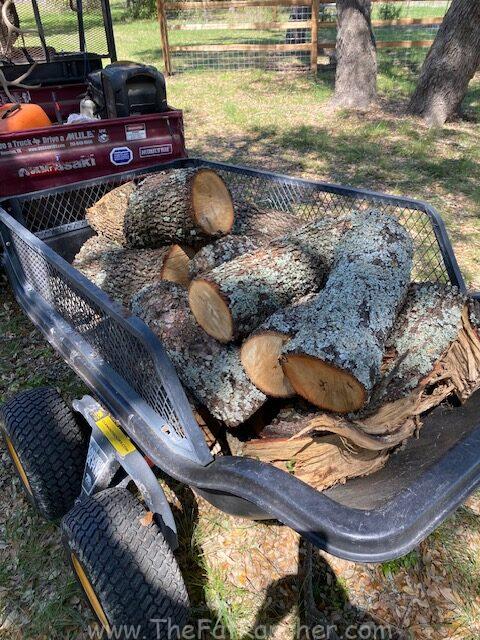
We’ve had several weeks of cold weather here, and I’ve been putting all this dead oak from the drought to use in the fireplace.
The Fat Rancher likes to think of himself as burly. However, splitting logs isn’t how he likes to demonstrate his manliness. Yup, “better livin’ through power tools” has always been my motto.
So when I started looking for a wood splitter, I took it pretty seriously. 20 ton, 30 ton, skid steer, tractor or gas engine powered, I looked at a bunch. And the prices pretty much ran the gamut.
Then I spied the Predator 20 Ton Log Splitter from Harbor Freight.
Now, this splitter has a smaller tonnage than some other power splitters. But it is very unique from others in one very special way: The location of the hydraulic cylinder.
Why It’s Special
Most splitters have the hydraulic cylinder (HC) in line with the wedge. That is, the HC is on top in line with the log. Now this may transfer the most power to the wedge, but it also means that logs can be split in only one direction of the HC.
The Predator, however, has the HC under the log bed. This means that it can have a dual sided wedge, and split logs in both directions. This makes the Harbor Freight Log Splitter unique.
This may seem trivial. But as anyone who has spent time splitting logs can tell you, the return time to reposition the wedge is often the same amount of time to drive the wedge. This means that splitting in only one direction splits 1/2 the wood in the same amount of time that splitting in both directions.
The result is that, instead of cooling your heels while a conventional wedge reverts to the open position, you are reloading your splitter at each end of wedge travel. This dramatically increases the throughput of the splitter. Place a log, split it in half, take a half and move it to the other side of the wedge and return.
The Specs
The Predator has a capacity of 23.5″ length and 16″ diameter. This, and the 20 ton strength has been more than adequate for the trees felled on Hidden Oaks. I have yet to run into a log that couldn’t be split properly.
The splitter comes with a 6.5HP Predator gas engine with, very importantly, a fuel cutoff valve. If you have had the “ethanol blues” before, you know that leaving fuel with ethanol in the float bowl of an infrequently used power tool will bugger it up but good. So every time I shut down the engine, I run the fuel out of the carb. That way, when I get ready to start it again, no fuss.
I’ve never had a predator powered tool before, so I was cautiously optimistic that it would be reliable. I’m happy to report that after two season, there have been no issues with the splitter.
The splitter comes on wheels and has a 2″ ball coupler. It’s not designed for road use, but rather hauling around the ranch (which I do with the Mule). I bought a long BBQ grill cover from Home Depot to cover it. It fits nicely with two hook/loop straps to keep it from blowing off.
The Splitter proved hard to find in the Harbor Freight stores. I think it is a combination of popularity and bulk that conspire for low inventories. However, it is readily available from the warehouse. You will have to spend $75 on freight, but since the splitter is normally only $749.99, you are still saving a bunch over the big-box stores.
Assembly
The product comes in a crate and requires final assembly. This includes assembling the frame, wheels, and coupler. Be sure to buy some hydraulic fluid and oil to complete the assembly.
Uncrated log splitter
The control, ram, engine and pump are preassembled on this Harbor Freight Log Splitter. They need to be mounted and tubing installed.
Power tools!
Hardware kit and ram assembly
Packaging was great, with all small parts and connectors blister packed on a card (helps keep small items in sight until assembly).
Assembled chassis with hydraulic reservoir
Completed Harbor Freight Log Splitter fired right up and was ready to go.
Fully assembled splitter
At $750 (plus shipping) the Harbor Freight Predator log splitter is a great value. Surprisingly, HF doesn’t do a very good job of highlighting the most awesome feature of this product: Bidirectional splitting. Go figure.
Is it the beefiest splitter on the market? No way. But it does an admirable job on a budget. I’m into my second season, and there are no issues. I’ll follow up on this thread if there are any changes.
2023 Update!
This little splitter is still going! Every year I dust it off and split a half cord.
Who says there’s no inflation? This year the Harbor Freight Predator log splitter has increased in price to $999. Still, it’s a great value in my opinion. It’s still the only splitter I have found with the dual splitting action.
Here I show some of the unique engine features which make this more than a run-of-the-mill product.
Watch the dual splitting action which speeds up the wood splitting task.
I haven’t changed my opinion. This log splitter has been a useful addition to The Fat Rancher’s tool chest!
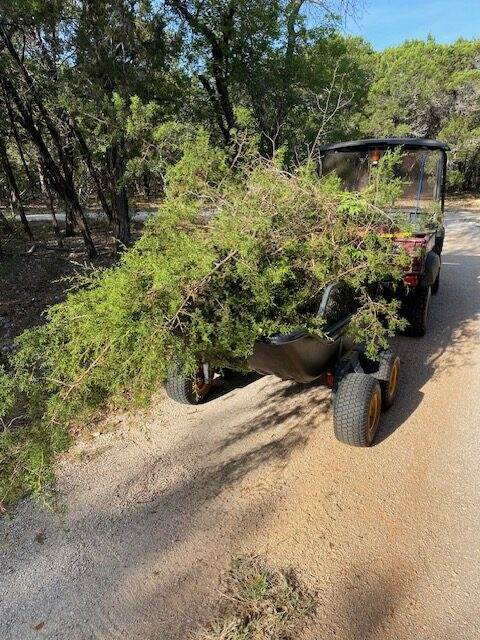
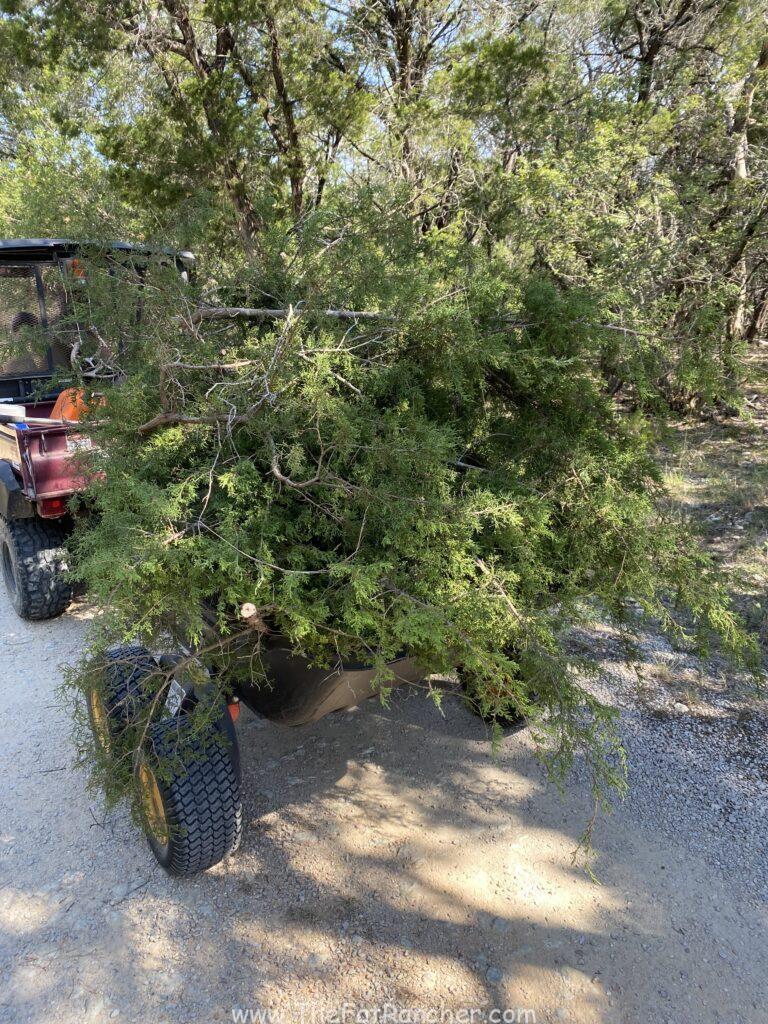
You may ask yourself, “Why does The Fat Rancher need a pruner?” Well, that’s because he has to beat back Juniper seedlings on a regular basis. And the Kebtek Battery Powered Pruner has turned out to be the perfect tool to keep those “cedars” at bay.
Part of my wildlife management plan includes managing invasive species. No doubt, the Juniper tree (Juniperus Ashei) is one of those plants that tend to over-proliferate in Texas.
The common juniper throughout Central Texas. This tree often forms extensive low forests or dense “cedar breaks” on the limestone hills and slopes of the Hill Country and the Edwards Plateau. Considered an invasive weed species over much of its range.
Texas A&M Forest Service
Oh, the joys of Juniper!
If I only had a dollar for every clipping…
The Kit
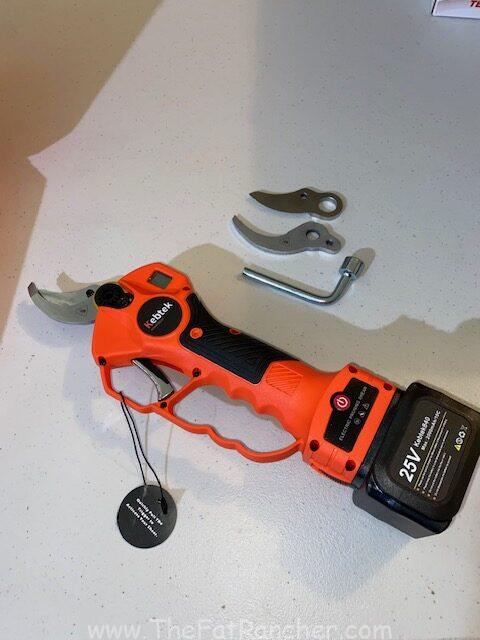
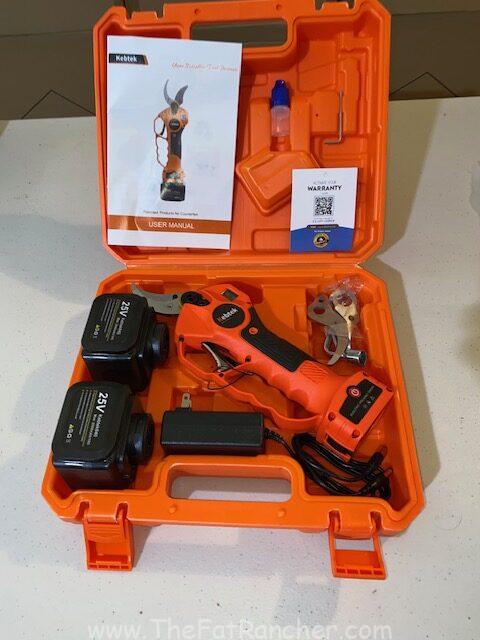
The Kebtek pruner looks like an ordinary pruning shear but with the addition of a 25-volt battery pack and trigger. The entire kit includes two sets of blades, two batteries, charger, and oil.
The pruner itself has an LCD cut counter (just in case you want to keep track of how many nips you have made), along with a controller to activate the pruner. The circuitry allows you to select a wide opening of the shears or a narrower opening, which speeds up the number of cuts you can make by only opening the shears halfway.
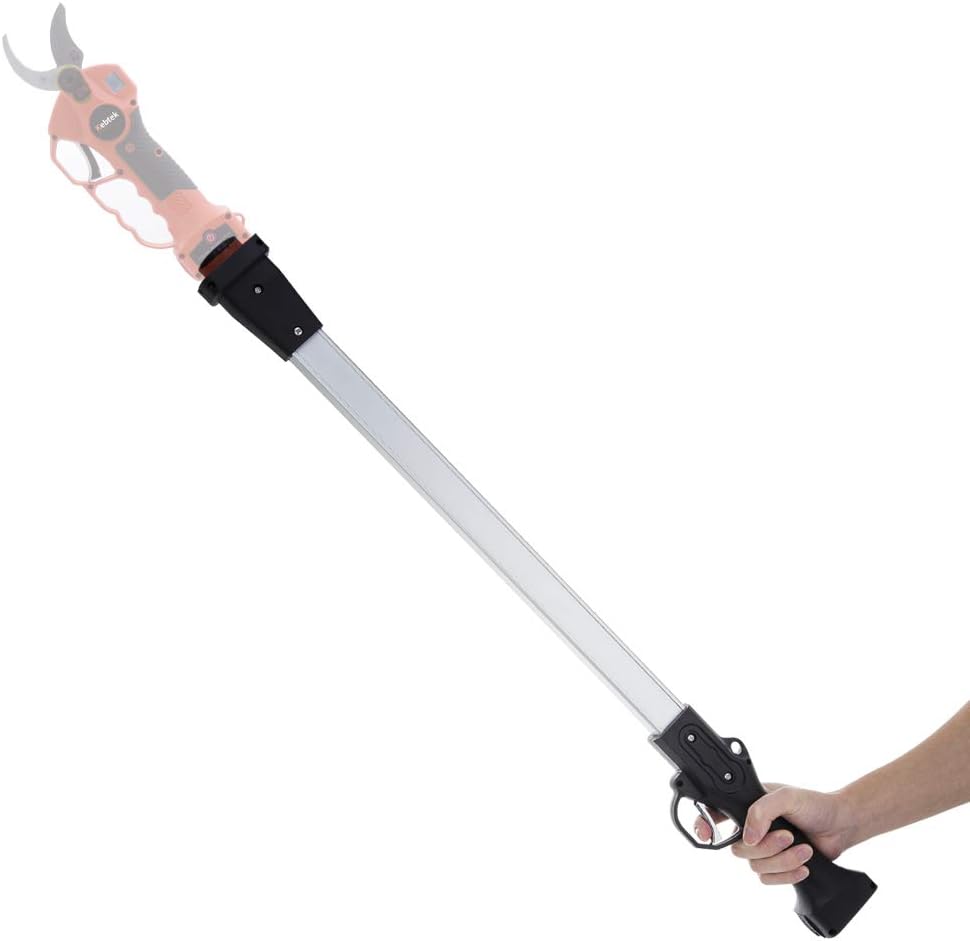
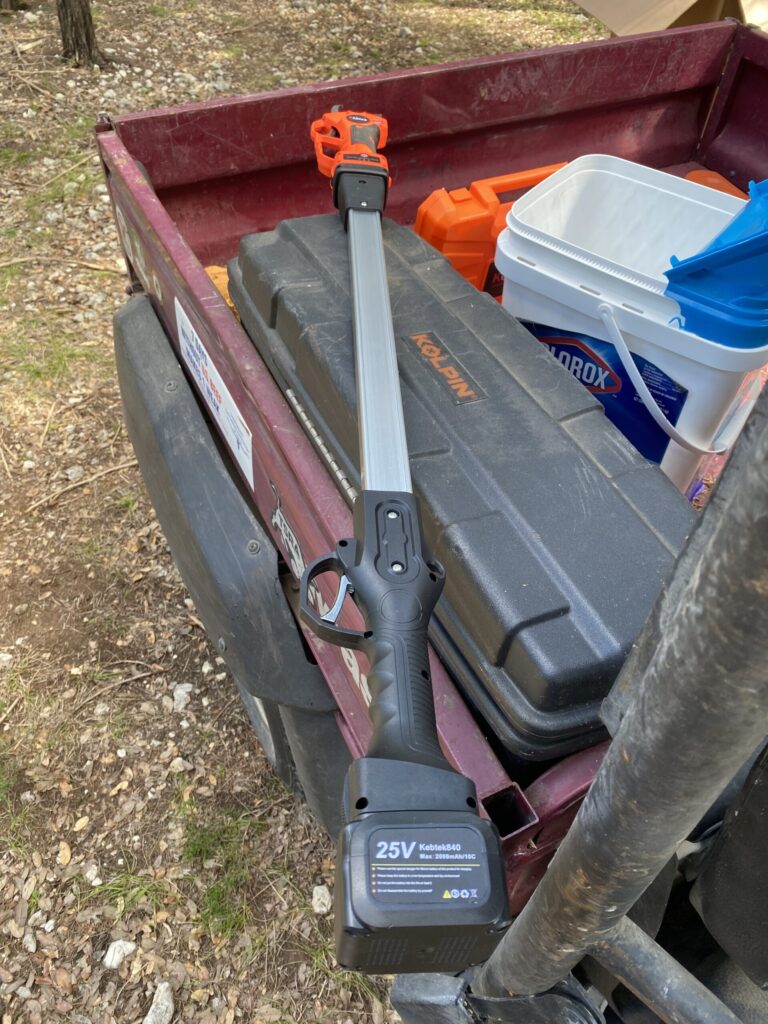
An essential accessory to the pruner is the extension wand. I chose the 32″ extension, which means I can stand nearly upright and clip off seedings at the base. Wielding the pruner at the end of the extension handle does make the wrist sore over time. However, this is just due to the physics of an arrangement like this. The battery does help a bit for counterbalance.
Photo courtesy of Kebtek
The extension handle is an indispensable option.
In Action
The Kebtek battery powered pruner is powerful. Most everything that can fit in the shears can be cut. And if a branch is a little too tough for a complete cut on the first activation, a second squeeze of the trigger usually takes care of the rest. Make no mistake: This little bad boy will take off your finger if you should make that mistake. This is not a tool to leave lying around when there may be children about.
The pruner in action.
Safety features include an immediate stop of the blade when the trigger is released, auto shutoff when unused for a minute, and the ability to “park” the blades in a closed position.
Conclusion
I’ve had the Kebtek pruner for two years now. Not only does it take the backache out of obliterating cedar saplings, but it has been very dependable.
During the time I have had it, I have had to charge the batteries exactly once. Now, I don’t spend hours on end clipping Junipers. However, the battery life should be more than adequate for the occasional pruning exercise. The cycle time is fast, even more so when using the narrower jaw setting.
The Kebtek battery powered pruner is now a fixture in the “frunk” of my Mule.
Our Kawasaki Mule, often thought of as a convenience, is actually an essential item on the ranch. Trailer accessories add to this utility.
In addition to providing transport on unimproved roads and pastures, it has proved invaluable in the workday tasks on the ranch. Specifically, hauling and moving equipment.
I’ve written about the Polar HD Utility Trailer in another post. Incidentally, going on five years, this trailer has been indispensable.
The Mule has a 1.25″ receiver mounted to the axle for towing accessories. In the past, I swapped out a ball hitch and tow ring as necessary for the task at hand, stowing both of these items in the bed of the Mule. This is entirely serviceable but not that convenient. Ever lose a lock pin in the pasture? What a waste of time.
This year I purchased a Top Tow multi-function tow ball with an integral clevis hitch hole and what I call a “strap pin.” The Polar HD uses the clevis hitch, and the 2″ tow ball works nicely to move around the pipe trailer. The strap pin can be used to attach grubbing chains or tow straps for when you need to winch your equipment out of the mud, as I have had to do on multiple occasions (always pay the extra for a four-wheel drive!!).
A cautionary note: Using the ball on a trailer hitch for winching out equipment is very risky. Tow balls aren’t made for this purpose, and if they fail under load, they can make deadly projectiles. The strap pin may fail similarly, but unlike the tow ball, it is attached at two points. This makes it less likely to become a projectile during a failure.
For the Polar trailer, I purchased an EilXMag magnetic hitch pin. This handy trailer attachment has a large, rubber-coated, red handle (to stand out if it falls in the pasture) and a permanent magnet to hold it in place. So you really don’t need that retaining pin except for safety’s sake.
Both of these trailer accessories are a convenience buy, available from Amazon and other online retailers.
When choosing homestead property features, one of the key qualifications is how you plan to use the property.
How will the property be used?
Obviously, if you are looking to become a hermit, seclusion from prying eyes may be a priority for you. A densely wooded property down a modestly maintained dirt road may be in order. However, if you plan on grazing animals, you will need a pasture. That means clearing trees and potentially amending the soil.
So it is wise to plan for this need in advance. Otherwise, you might find yourself spending a lot of time preparing land for feed plots.
Out here in Texas, the landscape varies from county to county. In West Texas, you will find sand, agave, and yuccas predominant. So you won’t see many cattle. As you go east, rock outcroppings and the cactus that seems to thrive in this environment (especially Prickly Pear) are the order, along with Mesquite and Juniper (known around here as “cedar trees”). The further east you go, the sandier then clay-like you will find the soil. And so too, the treescape will change.
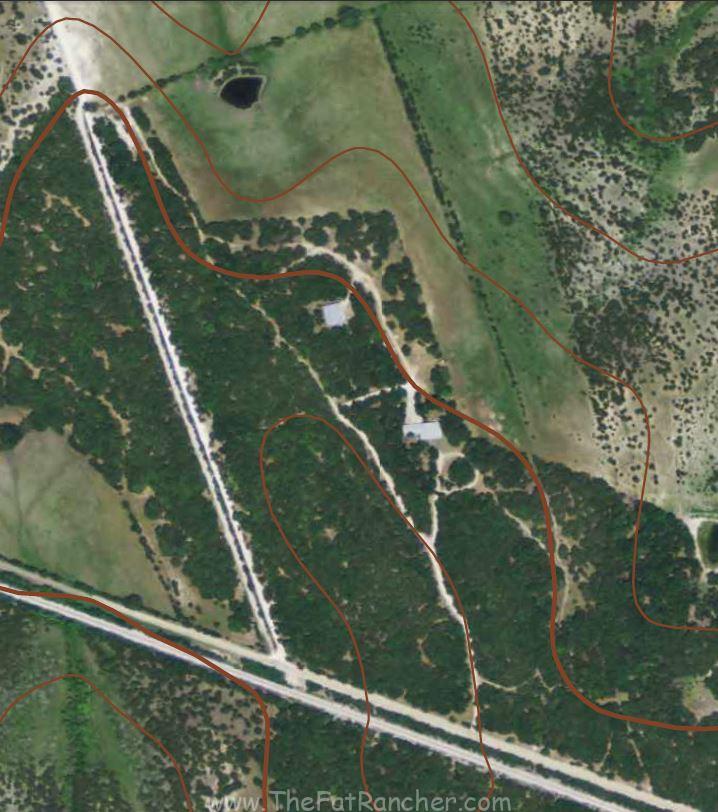
Topographic map of the Author’s ranchette. The tank at the top of the photo was created in a shallow valley descending into the adjacent property.
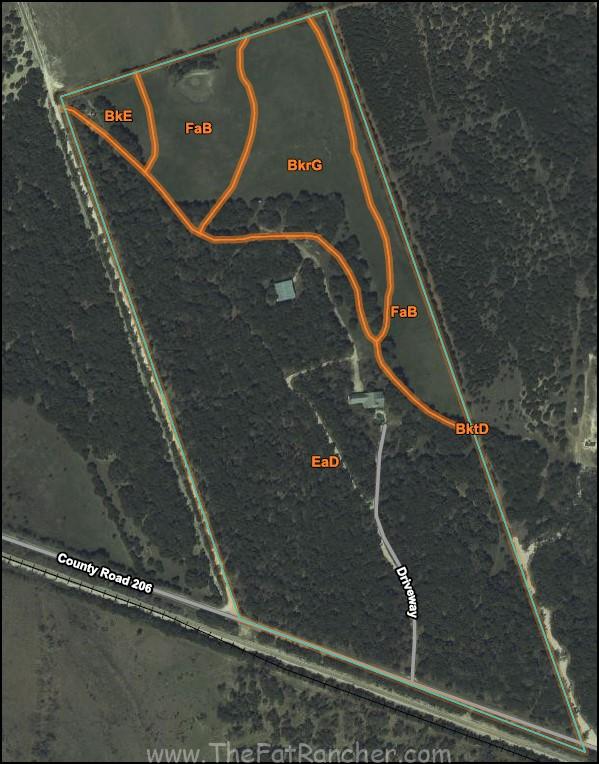
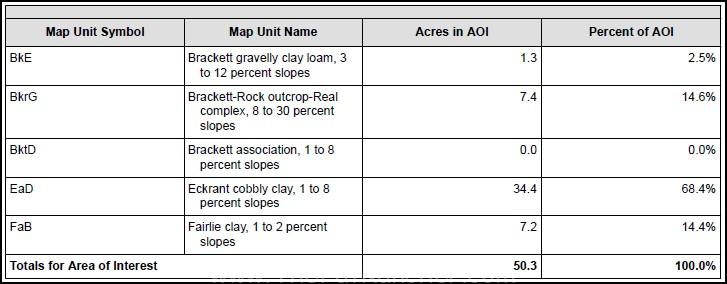
Soil map showing the change in soil types by elevation. Note how the Juniper cover roughly outlines the Eckrant cobbly clay. Coincidence? I don’t think so.
I’m not a soil engineer so I couldn’t explain the differences. However, I will tell you that the section of FaB Fairlie clay has captured in the mud my ATV multiple times!
View
My wife and I are partial to views. So hilly areas seem to have an allure for us. However, that view may come with a price. We have found that many view-worthy properties do not have adequate pastures for cows. Also, while the hilltop may be breathtaking, the weather may be an issue. Lightning strikes and high winds are not uncommon.
Just as important, that view may change. The ranch next door may be subdivided, morphing that view into a birds eye vision of other people’s “little slice of heaven.” So unless you are remarkably well-heeled and can afford to purchase a large enough ranch to control that view, you may be taking chances.
Water
In west and central Texas, water is king. Live water ranches easily run 50-100% premiums. It makes sense. A river or lakefront property is aesthetically in demand and commands a recreational value. Poor men like myself often rely upon man-made water features, colloquially referred to as “tanks.” These are damned ravines where the rain runoff can be captured for aesthetics or livestock water.
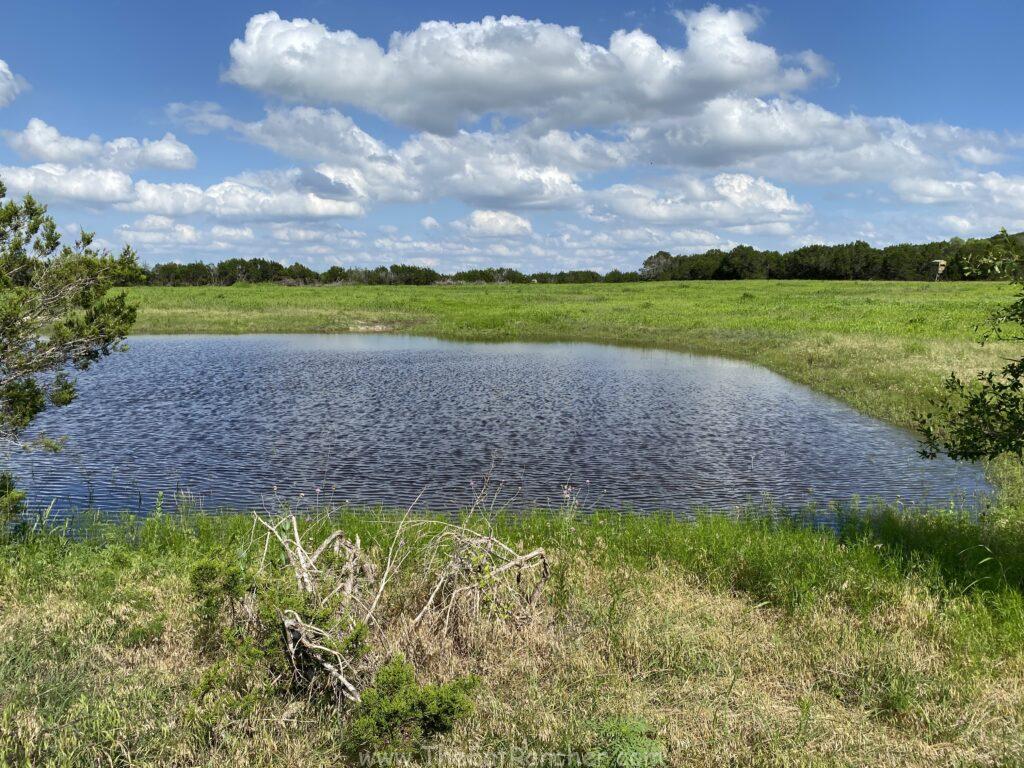
The author’s tank captures water from the Fairlee Clay
Having a topography on which you can catch runoff may be essential for your homesteading operation. Owning a riverfront or lakefront may be priceless for entertainment and aesthetics. Whichever your choice (or your budget!), you should ensure that your planned purchase suits your present and future needs.
Home Sites
You will want to make sure that the home site you envision is supported by the soil and topography. Many areas here in Texas are subject to severe runoff during storms, and mitigating the adverse effects of runoff can be costly and challenging in construction. Similarly, floodplains need to be accounted for. Having a portion of your property in the floodplain can mitigate property acquisition costs. Just make sure that your planned home site and access roads marry with mother nature’s natural drainage.
Here in Texas, wildfire needs to be taken into consideration. An adequate buffer zone should be around your house so that, should the worst occur, you will at least have a fighting chance at saving your house until help arrives.
Utilities
Getting power to your new homestead can be pricey. Typical above ground power will cost between $5-10 per linear foot. Expect to add another $1,200 per 500 feet for installation of a utility pole. Underground wiring can easily double or triple that cost. So finding a homestead with existing utilities can be quite a cost savings. Check with the local power company to get an estimate of how far they will need to install infrastructure and if there are any incentives or payment plans to do so.
It is the rare rural property that has municipal water. But they do exist. Of course this water is at the road and will require trenching to get it to the prospective home site. Building a well may be preferable, especially if the water will be used for irrigation.
Local water tables will determine how deep the well must be and what kind of production can be accomplished. Your best resource is a local well driller. They will have the experience to give you an accurate estimate of “how deep and how much (water and $$$).” Water wells in Texas can run from $5,000 to $25,000.
Access
How you will get to your new homestead should be considered. Depending upon your travel needs to get to town, that trek may be trouble free or tiresome.
The best of all situations is a paved county road. However, there may be a tradeoff with a loss of seclusion and vehicular traffic. Other times the road to your property may be a county maintained road base road. Depending upon the use, this may be palatable or a suspension jarring nightmare.
The sad fact is that the old adage of “The squeaky wheel gets the grease” is especially true when it comes to county maintenance. Depending upon the number of homesteads and their respective political pull, one may find the county maintenance satisfactory or untenable. Having a good working relationship with your county administrators will go a long way.
Check what kind of traffic is prevalent on your prospective access road. If there is a gravel pit or some other heavy equipment traffic of a continuous nature, be prepared for challenging road surfaces. County roads are seldom built to the same standards as urban roads, and may not tolerate dump trucks and filled 18-wheelers in continuous service.
Nirvana: A county maintained, paved, infrequently traveled road.
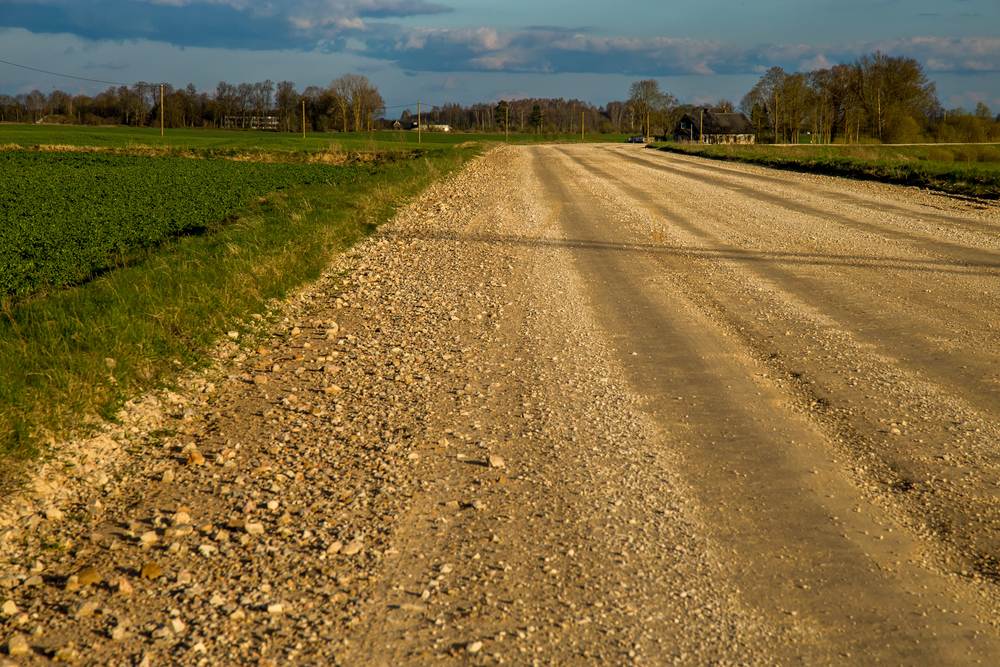
The typical packed road base county road.
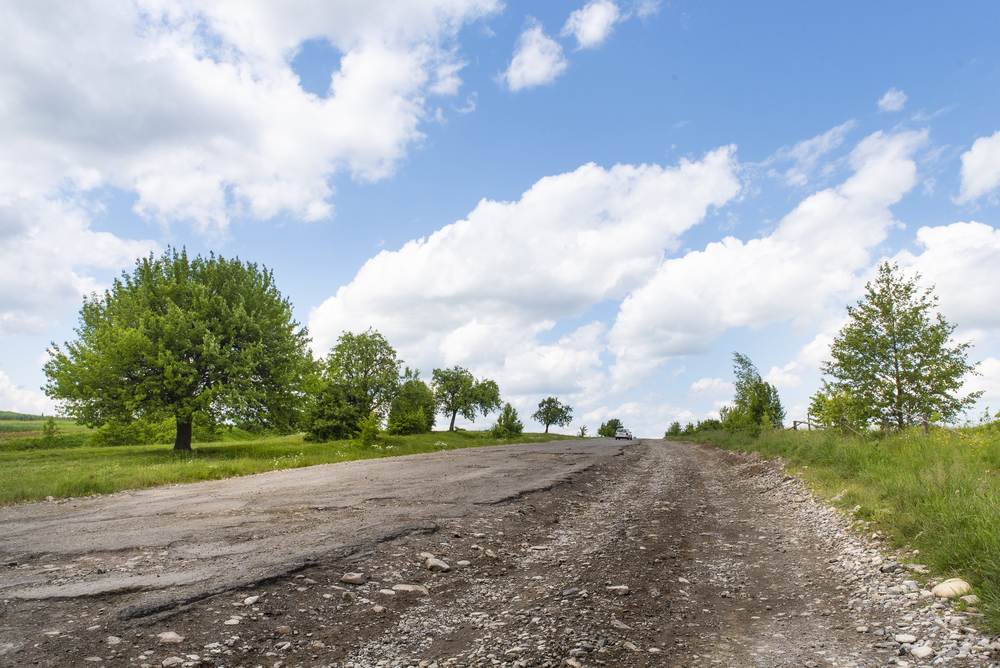
Unmaintained paved road. It only gets worse!
Keep in mind that “county maintained” means different things to different counties. These roads can provide basic, serviceable access on a year round basis. However, some maintenance contracts look like they are serviced by “Bill and Ted’s Excellent Road Maintenance” and will not look much better than if you maintained them with your tractor. I have traveled some road that looked like an old-fashioned washboard and would rattle the fillings out of your teeth.
Private Roads
A word on private roads: My wife and I have looked at many properties serviced by private roads. Most were a disaster. It goes like this: The road is built by the developer but no association is formed for maintenance. Nobody wants to foot the bill for keeping the road serviceable and it falls into disrepair. The longer it is not maintained, the worse it gets. Every rain, every freeze, every cement truck for a new home etc., it gets beat up. Soon you are thinking a four-wheeled drive is necessary to traverse it.
The other scenario is that an association is created, but once that association is turned over to the owners, they stop spending money on the road. Once the association stops enforcing dues for repairs, a special assessment is required due to the large cost involved to rehab the road. That may require a super-majority to approve, which obviously is much harder to secure. At this point all the homeowners are left with crappy infrastructure and no way to pay.
In my opinion, you either have county maintenance or a strong property owner’s association (with teeth) to insure that the infrastructure is maintained. I know, many think property owner’s associations are an infringement on your freedom. Well I disagree. Since the beginning of time people have gathered to self-govern. POAs are nothing different. And who wants to invest hundreds of thousands of dollars in a homestead, only to have the value slagged because the guy down the street thinks you should pay for all the maintenance yourself? Everybody’s got an opinion…
These are just a few of the additional considerations when choosing a homestead property features. Careful determination of your priorities can save a lot of time while shopping.
None of the following constitutes legal advice. Always consult a licensed professional.
OMG! The Fence Costs How Much?
Sticker shock: OK, now you’ve received one or more bids for your homestead fencing. The pricing might take you back a bit. You may have to forego the new tractor, disker, or even the livestock themselves. The dream you thought you could afford just became unaffordable. You’re starting to think, “how hard is fencing really?” You should think about this long and hard because fencing, especially over rugged or wooded terrain, is tough without the right equipment.
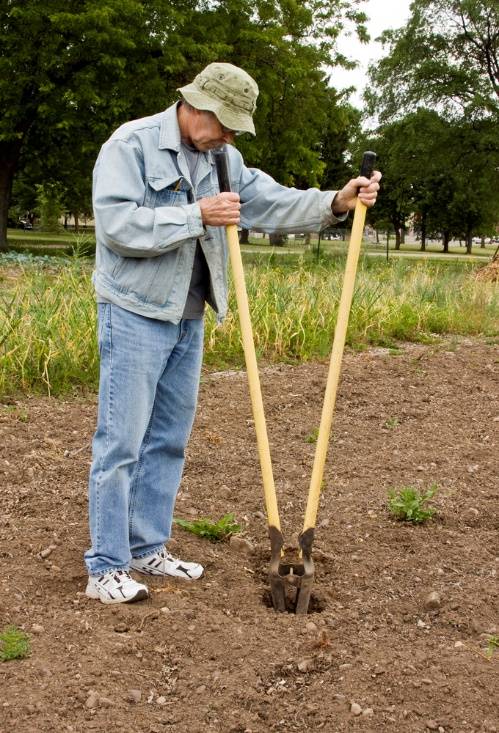
Before you dismiss your contractor’s bid or multiple bids, it might be wise to invest in a simple $20.00 post-hole digger at your local hardware store. Attempt to dig one hole on your line for just one post, say three feet deep, and see how that goes. Chances are you’re going to realize that specialized, heavy equipment is a time saver for ANY and ALL types of fencing you might entertain. You may realize that $10 a hole with a $200 minimum is just a drop in the bucket, especially when you have 300+ holes to dig!
At one time, my wife and I owned a property in Salado, Texas. We elected to fence most of the property ourselves. This involved a lot of land clearing to accomplish the task. After spending the first four months bent over a chain saw and bending both the front and rear bumpers on my truck beyond repair, I was utterly spent. In contrast, my neighbor had hired a contractor to clear his line to build a fence on his side. The contractor had a specialized skid-steer with a flailing chain attached to a huge drum. He cleared more in four hours with that machine than I’d done in four months. I gained some serious perspective and humility from that experience.
You’re right to be concerned about farm and ranch fencing costs, though. If you’re going to sharp-shoot your bids, doing this on your own is best. Questioning the proposal or the value of the materials should be done tactfully by performing your own research away from the contractor. Be sure to take into consideration the availability of materials needed and how much it weighs. Where and how far do you have to go to get it? How much time will be involved in the simple logistics of just getting the materials to your property? Believe it or not, this is an aspect of your bid that your contractor may be willing to negotiate. Your contractor probably doesn’t make much on materials or logistics. If you can go and get it, purchase it and bring it and stage it, he might be very happy to work with you on this point.
Heavy Equipment
If you’ve never worked with or operated heavy equipment, do not attempt to negotiate this part of the bid. One 200′ long roll of 5′ tall woven “horse fence” weighs approximately 300 lbs. Imagine hauling that in the back of your 1/2ton pickup or on your 500 lb GVW trailer. If you don’t have the right equipment to haul it, it may not make sense to negotiate his 10%-15% profit on the materials.
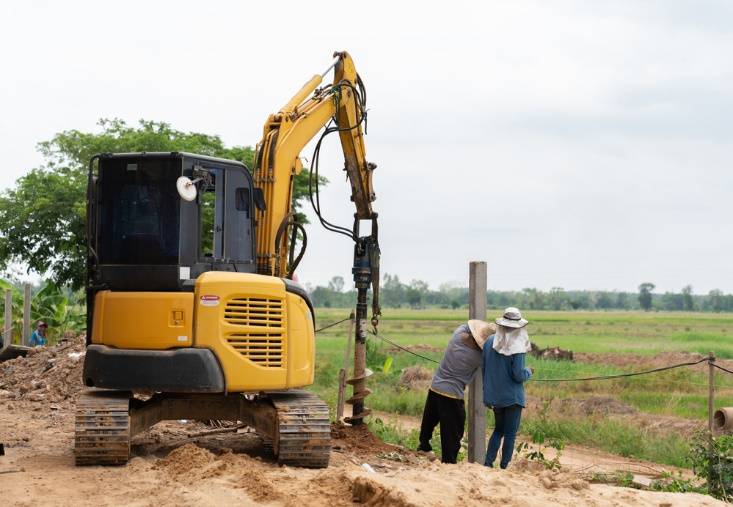
This might be the best money you have ever spent. Take into consideration the upkeep, fuel costs, and on-site time vs. actual working time. These are all things the contractor must plan and prepare for. Renting equipment on your own is inadvisable. Your contractor knows the equipment, will transport it to your site and will deal with the inevitable breakdowns. You are probably not prepared to wait three days for a hydraulic fitting that splits in half when the auger bounces off a solid piece of rock. Your contractor is. It’s his equipment. He probably has two spares in his rig. These are the things you should be thinking about before dismissing that bid that gave you sticker shock. The bid will most likely be fair, especially if your contractor comes highly recommended, and you took the time to validate his recommendations.
Other Considerations
This is the one. You know it. The perfect place! You and your spouse love the house, the school district comes with high scholastic achievement, and you’re confident THIS is the place for you and your family. Keep in mind, unless the property is a brand new build with a brand new fence and brand new roads, you’ve probably got some work ahead of you.
Looking at these fence factors in advance and objectively listing these potential issues up front is all part of your contract negotiation on an agreed purchase amount. Chances are the existing owners are retiring from farming or ranching. If they’ve been there for years, assume they know all the issues on the property. However, don’t make the assumption they will disclose all of them to you without prompting. This is where it will serve you best to have an objective opinion about things that are in question.
Let’s assume you know very little about fencing. You can see that the fence line is in disrepair, but you have no idea how to fix it, much less assign the repairs a value. The existing owner has been living with the fence this way for a very long time. To them, the fence is still as good as the day they put it up 30 years ago, and their cattle on the land is a testament to that. They may not negotiate any money off the contract from your own evaluation or because it “looks old.” But, they might be willing to deal with an objective professional opinion.
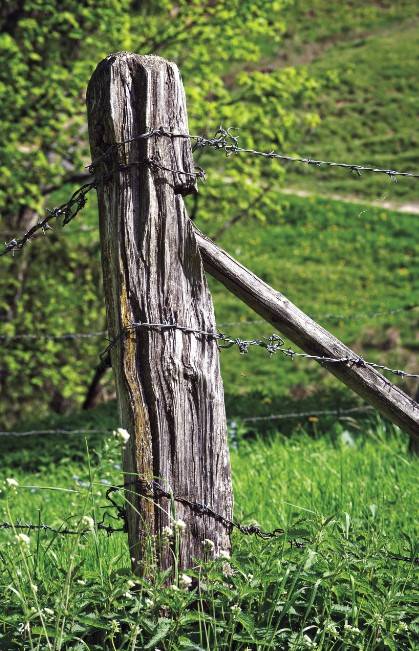
When you see sagging or broken barbwire, posts pulled up out of the ground, concrete footings pulled up, and gates that do not open, much less line-up, that fence has moved. Keep in mind that all homestead fencing moves with soil swelling and contraction or years of cattle pushing on it. If you can’t open a gate, you can’t use it. You can’t graze your animals in that pasture if the fence is down.
Most farmers and ranchers understand and can appreciate contingencies when it comes to real estate, especially when it comes down to the welfare and security of livestock. Getting a professional objective opinion, even if you have to pay a disinterested party $500 a day to inspect it. This might save you $18,000.00 on replacing a half mile of fence and gates. The sellers might even repair the fence to the point of usability upon move in if you ask.
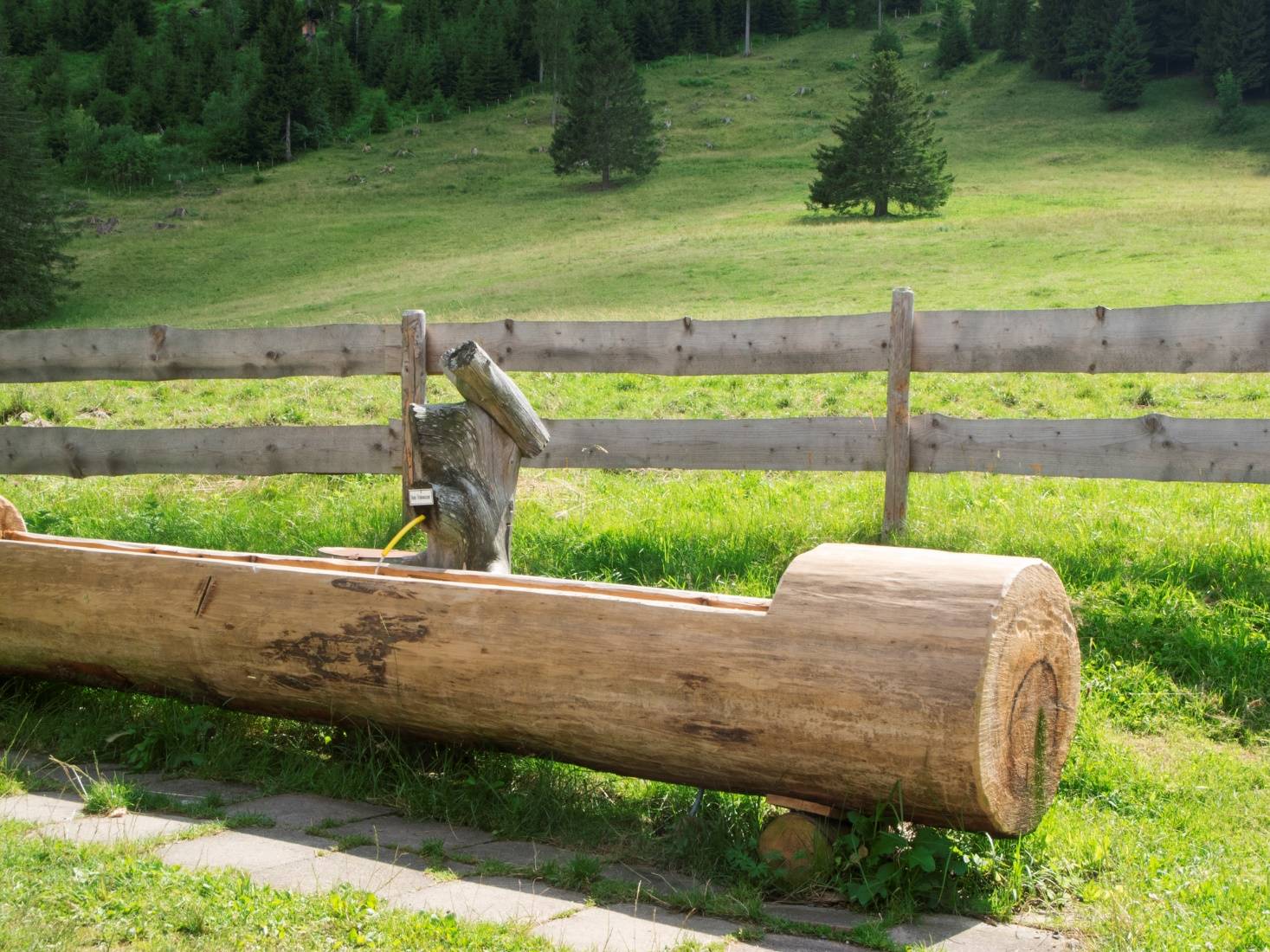
There are many other things to consider when looking at a fence line on a property. If there is a water trough next to a fence with a hose bib, but the tub is dry, walk right up to it and attempt to turn the water on. If it works, GREAT! If the faucet doesn’t work, ask why and when it stopped working. Now, ask the current owner where the pipe is and how it is run to the water trough. Knowing where existing subterranean electrical and water lines are is critical to being able to put up a new fence or repair an old fence with confidence.
Conclusion
Keep in mind that a fence is just a fence. If it worked for the existing owner, chances are they don’t feel the fence adds to the value of the property or, conversely, takes away from it. Unless they have just paid thousands of dollars for the fence to be installed on the property! And that is precisely what you should be thinking about when looking at homestead fencing system on a prospective property. Fencing is hugely expensive regardless of the type you choose, the style, or the purpose the fencing will serve. Ask questions, plan judiciously and do it right the first time. The payoff may be savings in time, money, and aggravation.
None of the following constitutes legal advice. Always consult a licensed professional.
It’s Just a Fence. Right?
Whether it’s existing ranch and farm fencing on a property you are considering buying, fencing the perimeter of a new property, or cross-fencing your interior, there are some constructive perspectives and information that will help you with making fencing decisions for your ranching adventure.
Considerations
Cost
The Physical Environment
Neighbors
Your Livestock
Local Wildlife
Plan ahead
Choose carefully
Consult a survey
Verify existing fencing with the survey
Review neighboring fencing practices
Learn about adjacent gates, pens, and corrals
Check prevailing fence techniques
Seek out contractor referrals
Get timelines and pricing in writing
Planning
Before fencing plans are made, you should sit down and talk about what you plan to do on your property. Have a 1-2 year plan and a more extended 4-5 year plan for your property and your livestock. Repairing existing perimeter fencing or installing new fencing will be a priority. Cross-fencing comes later. And that can be done, at least in part, with a grant from your local AG Extension Office! When you’re putting together a plan, take into consideration the types of livestock you wish to have and what the quantities will be. It’s also a good idea to learn about fence laws in your area. Next, plan load-out locations, corrals, shelters, and permanent facilities.
Nothing is worse than putting up a fence only to dig it up or remove it to install shelter, water, and electrical lines. Pipe stub-outs for this purpose can be placed in advance. You should consider accessibility as the most critical factor when determining your fence line and do so by keeping all types of weather in mind. There is nothing worse than erecting a shelter for your animals that fills up with water in November or having a shelter that you simply can’t get the feed to in a snowstorm. This is where the help of the current owner can be of GREAT value to you.
All you have to do is ask during your tour of the property. The key is knowing what to ask and put your questions in the context of the season you are asking about. Talk with your potential future neighbors about access and wind direction. Chances are, all their shelters are all orientated in a specific direction for a reason! You can learn what works best for your property and incorporate those planned facilities within the scope of where your fence lines will be. In the case of accessibility, you may have to fence around environmental factors, like flood plains, gullies, streams and rivers. While roads may be easily accessible in the summer, mid-winter may be an entirely different experience.
Designing a fencing system has traps you can fall into if you’re not careful. Consideration should be made relative to your pocketbook, your environment, your neighbor, your livestock, and the wildlife interacting with your fencing. The impact of your fencing on your animals, your neighbors, and your property can be significant.
Approach your fence project methodically and objectively, keeping in mind that fencing has systemic effects that are often unintended. In fact, fencing can have as many detrimental effects as positive effects. There is nothing worse than spending thousands of dollars on a new fence only to have to tear it down because it won’t work as an all-season fence or finding out you built it on your neighbor’s property!
Unfenced Land
Your choice of farm and ranch fencing will be based on several factors, not the least of which will be financial and the type of animals or security you seek to protect. Remember, this includes animals you desire to keep in and predators you want to keep out.
Costs for new fencing can vary widely across the country. Factors such as terrain, accessibility, raw material costs, and transportation all impact the final cost.
Survey
There is always a border on raw land without fencing, even if there isn’t a fence in place. A survey of the land you intend to fence is essential and should be provided to you for evaluation. Existing fences will be shown on the plot plan, and you can, in essence, “see” what you have by correlating that diagram to your physical property.
Without an existing fence line, you will only have flags tied to steel pins placed in the ground. These can be very difficult to spot. This is why you need to have an updated survey provided to you by the seller. The protection this affords you as a new or prospective buyer can not be overstated. Often you can negotiate the cost of the survey. However, this is most often a seller’s expense if they do not have a survey less than five years old. If the seller refuses to pay for a new survey, you might offer to split the costs. If you are purchasing a property, your real estate agent may be helpful in negotiating this.
In the end, a new survey may save you thousands of dollars. Knowing any easements or conflicts on existing property lines is imperative. This is also helpful when checking that your property taxes are accurate. Keep in mind that if a new survey is to be performed, you have a right as the buyer to be physically present during the survey. You cannot truly know what you have unless you are there when the survey is undertaken.
If a property already has a fence, the line will be verified by a new survey. Flags will be tied to objects above or near the point in the ground that is verified. Just because there is a fence up doesn’t mean you don’t need a current survey. Who owns that fence? There is nothing worse than buying a property and finding that the fence is already in dispute with the neighbor. Worse still, there may be a conflict of interest on the fence line that involves access to natural water flow, road access, or right of way.
The point is you must know what you own before you can build a fence. Assuming the fence line that is present is actually your fence is an assumption most people cannot afford to make. Accepting a fence line without a survey, then repairing and maintaining that fence after you purchase the property, could have onerous consequences if the fence itself is not on your property.
Rural Fencing in a Farm and Ranch Environment
Not only do you need to know the landscape and your property line, but you need to look at surrounding operations. Evaluate what your new neighbors are doing with their fencing, get an idea of how they are using their property, and what a new or upgraded fence’s impact on them and their animals will be.
There are several anecdotes related to this point. The first is about what a fence says to your neighbor. Imagine if you decide you want to keep exotic big-horned sheep. These animals can easily jump a 5-6′ tall fence, so you elect to put up a game fence 8′ tall. Much to your neighbor’s chagrin, you may have just effectively destroyed every single natural migration and game trail for that line of that fence.
You will potentially have disrupted years of routes of forage and habitation for an unknown number of species. At a minimum, you may impact your neighbor’s passion for deer hunting every year and crush any potential for a good relationship with that neighbor. The point is to get to know your neighbors and their operations before you decide to put up a fence that may affect them negatively. But there is also a practical reason for this. A fence line separating two properties can be shared in most states. By that, I mean if both parties build one single fence on that line, both parties can agree to split the costs of that fence!
There is another reason to get to know the neighbors of your new-to-you property with regard to your fence line. Many “agreements” have been forged on properties generationally. These agreements can be hunting rights, road access, seasonal usage, or even water rights for livestock; none of them may be in writing. For example, a family moved into an older ranch home needing a lot of work. One day their neighbor showed up asking to use the head gate in the corral that bordered the two properties.
As it happened, the head gate was sold as part of the property and the corral system around it. When the prospective owners inspected the corral, it was noted that there was a gate at that location between the two properties, but the gate was securely locked. The new owners were given keys to what they were told was “everything.” However, when they inspected the property, they thought the gate opening to the neighbor’s side was odd, but it was locked, so it was secure.
They had tried all the keys to that lock, but none worked. The new owners told the neighbor that they didn’t have a key to the lock, to which he replied, “Oh, that’s my lock. I have the key!” The neighbor brought his calves into the pen, successfully vaccinating them and spraying them for lice. This promptly infected all the new owner’s cattle. The point is this: You should drill into all of the “unexplained” at inspection. If you want something explained or are unclear about what is yours on your perspective property line, ask until you are satisfied. Nothing is worse than inheriting a feud or an unspoken agreement on a property line that will cause you nothing but grief.
Check Prevailing Fence Techniques
Once you know what you have and what you need to fence and what it needs to be fenced for, look around your area. If you live in Texas, used oil field pipe can be purchased relatively inexpensively. Wood posts are more common in northern states, especially in places like Idaho, Montana, and North Dakota, where soils tend to “move” with inclement weather, whereas pipe tends to sink or fall over. No matter where you are looking to build a fence, look around to see what others are doing. Chances are, what they have is the most economical and practical thing going in your area. Your contractor may specialize in one medium or several.
Find a LOCAL contractor. Selecting a contractor for your farm and ranch fencing is almost as important as your property selection itself. Find a company recommended by more than one person. Then verify those recommendations. Talk to the contractor about the other services they may provide. Chances are, you will need more than one contractor to assist you with your new ranching endeavor. Choose one that doesn’t want your money for materials upfront.
Never sign a contract with “draws” or “advances to be paid” on balance due throughout the build or the task without annotated completion dates or percentages of the work completed. As it pertains to fencing, you may have an urgent need to secure your animals immediately. There is nothing wrong with annotating completion dates or “to be completed by…” dates on any agreement you enter. The point is to be specific. If you need a corral with a gate and you are on a timetable or contingency, the time to let your contractor know this information is BEFORE their bid is submitted.
But any landowner knows that fences can make or break an operation.
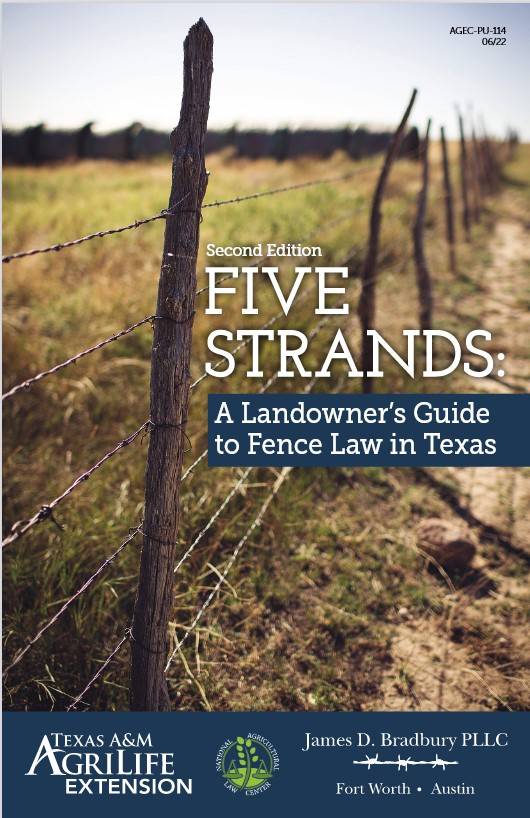
I would like to share a great resource (at least for *Texas* landowners). It’s called Five Strands-A Landowner’s Guide to Fences in Texas, Second Edition.
Five Strands: A Landowner’s Guide to Fence Law in Texas
This revised handbook is from our knowledgeable friends at Texas A&M Agrilife Extension and Bradbury PLLC. In it, authors Tiffany D. Lashmet, James D. Bradbury, and Kyle K. Weldon explain, in layman’s, terms fence law in Texas. And, even though the focus is Texas, there are some nice tidbits for everyone else too.
From the TAMU Agrilife description: “This handbook was written in terms that “normal people” (as opposed to lawyers) can understand and is designed as a resource that can be thrown on the dash of a pick up along with a ranchers’ other important documents. Our goal was to help answer common questions related to fence law that come up frequently for Texas landowners and livestock producers.”
Plus, it has some great photos of fences. Really!
Thanks to TAMU Agrilife for a great resource.
Did You Know?
Texas is an open-range state since the 1800s. Livestock owners are not required to fence in their livestock.
However, local county stock laws and the US and State highways create closed ranges
There is not a comprehensive list of closed-range counties. Contact your local sheriff’s office to find out if your county is subject to closed-range requirements.
Entering a neighbor’s property to clear brush could be considered trespassing. If your neighbor doesn’t consent to your clearing, you may have to back the fence onto your property to keep it clear.
If the fence is mutually owned, one owner may not remove it. Further, if your fence is attached to a fence owned by someone else, you must give 6 months’ written notice of your intent to disconnect your fence.
Photo courtesy of Britt Fisk and Connie Loveland via Texas AgriLife Communications
You may trim limbs hanging over your fence only to the property line. The location of the trunk determines the ownership of the tree.
Adverse possession is a thing in Texas law. This refers to the egregious use of someone else’s land. Grazing is not typically enough use to gain title. However, if you offset your fence into your land and your neighbor builds a fence on your land, you may have a problem. Offset fences are best supported by a property line agreement with the neighbor along with regular inspection for encroachment.
Thanks to Texas A&M AgriLife Extension service for this handy guide to fence law in Texas.
Mr. Bradbury discussed the two categories of Texas Water: Surface water in a defined watercourse (streams, rivers, lakes, the Gulf of Mexico) along with diffused surface waters including stormwater runoff prior to reaching a watercourse. Groundwater includes percolating (namely water percolating beneath the land surface, but not in a subterranean stream or river) and aquifers, and then Subterranean rivers (which do not appear in Texas).
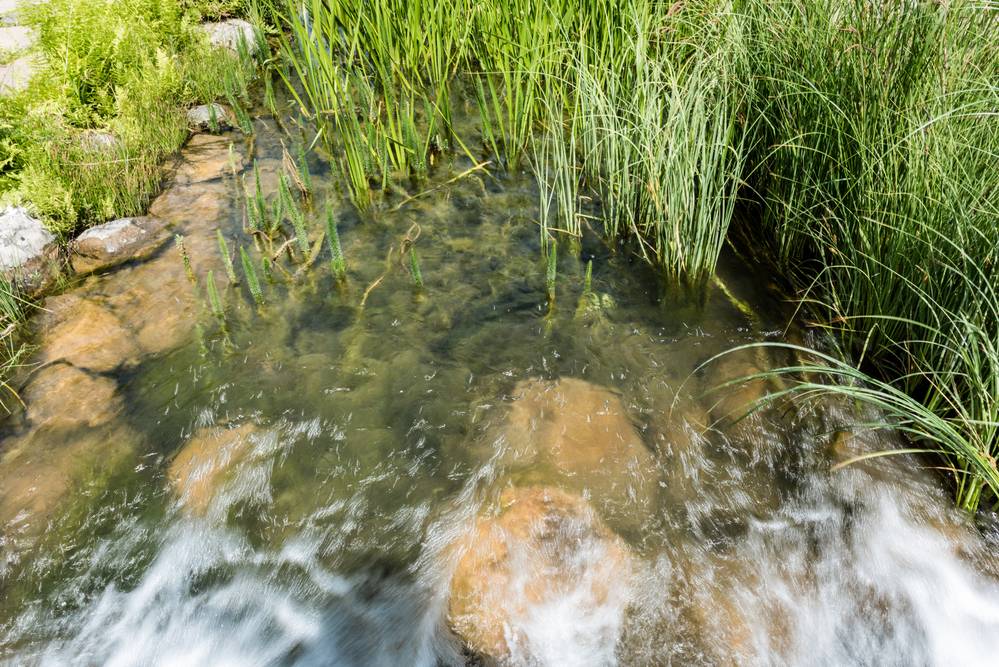
Mmmmm…. That looks clear and cool!
Surface Water
Generally, any surface water is owned by the State of Texas and governed by the Texas Commission on Environmental Quality. Typically, rights to water are governed by an established water right priority with some exceptions (namely oil and gas exploration and livestock).
Groundwater
Groundwater, on the other hand, may be governed by GCDs (Groundwater Conservation Districts) but the rights to it are owned by private landowners. GCDs are locally governed districts for the management of groundwater supplies, with limited management planning oversight by the Groundwater Planning and Assessment Team of the State of Texas.
Who Owns Your Water?
Did you know that a property owner may sell the rights to her groundwater? They can. And if you buy a property, it’s best to research whether those groundwater rights will convey with the land.
Between the continuing drought and exploding water demands from urban areas, water availability is a contentious issue in Texas. Bradbury displayed maps of water needs by county in Texas, with the highest demands around urban areas with limited groundwater capability. Projections show municipal needs exploding in 2030, and more than trebling by 2070.
If one purchases land with the planned use requiring surface water, then that landowner must apply for a water right with the TCEQ. The granting of that right is not guaranteed. Moreover, rights take priority based upon the date of granting of that right, and are subject to non-impairment of existing water rights. This can be problematic over time.
Navigable Waterways
Were you aware that navigable waterways are public? That means a stream or river deemed navigable by the state is fair game for use by the general public. Even if both sides of the waterway are privately owned, citizens cannot be accosted while using those waters for a lawful purpose.
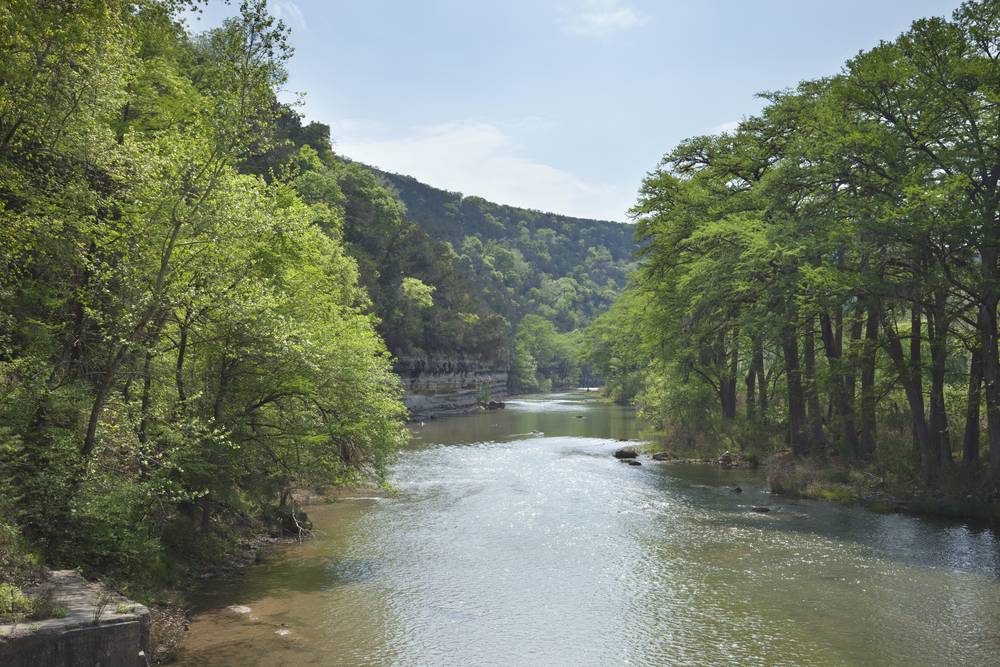
The Guadalupe River below cliffs of the Texas Hill Country during Spring
Rainwater
Rainwater is another animal entirely. Bradbury explained that rain falling on a landowner’s land may be owned by the landowner. Think rainwater harvesting systems. Similarly, rain flowing in unpatterned ways across the land from higher to lower ground is considered the property owners. As long as it hasn’t entered a watercourse… The same goes for diffused surface water.
Control in artificial ditches, tanks, ponds or rainwater harvesting systems may be used for any beneficial purpose.
Stock tanks have a limit of 200 acre-foot capacity when measured over a 12-month period. Limited purposes include domestic, livestock, wildlife management, and fishing (but not fish farming). If the tank is filled with diffused surface water, there is no limitation. If filled with groundwater, it must comply with GCD requirements.
Groundwater is governed by the rule of capture. That is, the landowner has the right to pump as much water as she wants, even if it drains his neighbor’s well (subject to GCD regulations and other exceptions).
Regulations concerning ownership and use of water in the state of Texas are fairly well defined and often mirror the laws regarding other minerals. Moreover, these laws and the case law supporting them are likely to become increasingly complex as the demand for water grows in Texas.
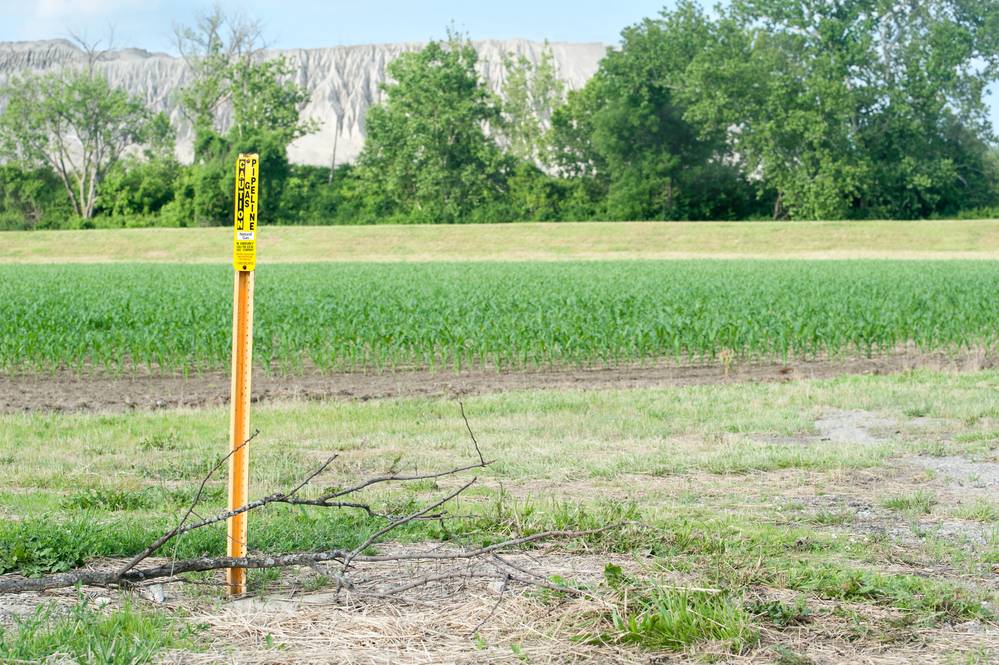
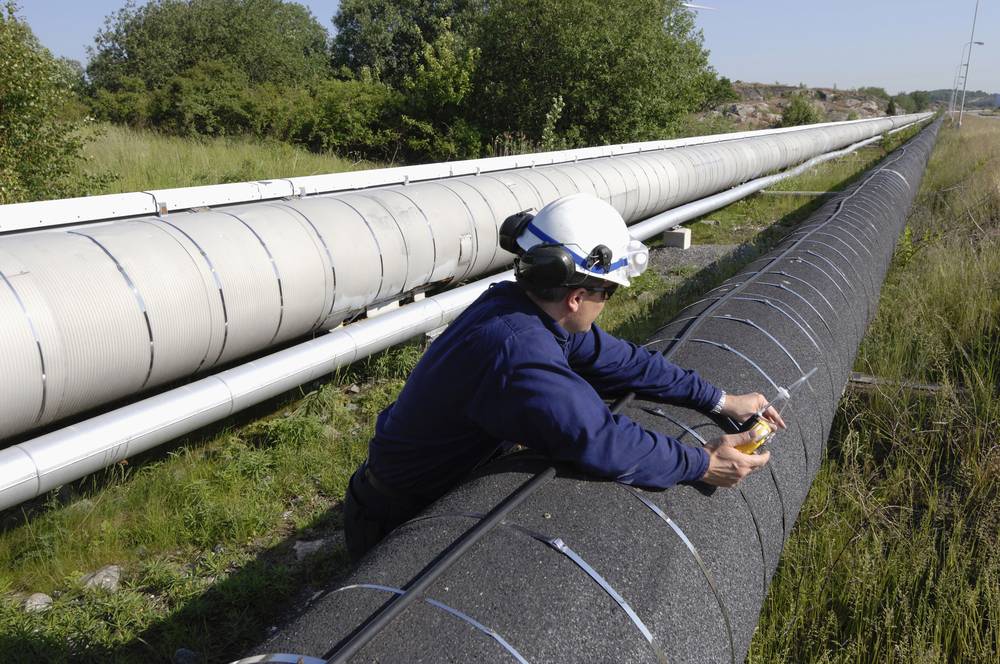
What if you purchased your “little slice of heaven” only to find out that someone wants to run a pipeline smack dab through the center of it? At the Texas A&M Agrilife Extension seminar “Owning Your Piece of Texas: Key Laws Texas Landowners Need to Know,” Jacob Merkord with Marrs Ellis & Hodge had a few suggestions for tackling eminent domain.
Public Good
In Texas, the definition of “public good” is broadly defined when it comes to pipelines. Some private organizations are empowered to directly condemn properties, while others have a more circuitous route. Either way, it’s not likely that you can avoid condemnation. However, there are some actions you can take to mitigate this negative experience.
Some easements are unavoidable. Some are profitable!
Eminent Domain
The eminent domain procedure typically includes an initial and “final” offer. There is no requirement to respond. The Government will then sue the landowner, which is most times inevitable on the road to an equitable offer. Landowners should not be cowed or shamed by the filing of a lawsuit. This is part of the process.
A commission will be empaneled (often “friends” of the presiding judge) and they will hold a Special Commissioners Hearing on the condemnation. Landowners must file objections within approximately twenty days. This is a HARD DEADLINE.
Check List For Easements
Make sure any agreement is in writing
Require notice before the survey crew enters your property
Limit the timeline of the survey access
Require restoration of grounds. This includes “double-ditching” excavation where topsoil is positioned separately from diggings further down. This permits backfilling with the crushed rock and then reinstalling topsoil to maximize aesthetics and encourage regrowth of natural groundcover.
Include an indemnification clause in your agreement
Limit access during wet or muddy conditions
Require that gates be closed after and during access
Eminent Domain Checklist courtesy of Mr. Merkord
Calling in the Big Guns
While no one likes hiring attorneys, the landowner deserves to be represented by someone who knows the law and likely is familiar with the tactics of the utility prosecuting the condemnation. Your investment in counsel specializing in eminent domain actions will yield benefits in maximizing the benefit of a bad situation and minimizing the impact on your land.
Merkord notes that the objective (according to case law) of the judicial process in the condemnation context is to make the landowner whole. Thus, representation by an attorney who can cite case law and land market facts will be instrumental in getting the landowner just compensation. Per a City of Austin case: “The proper inquiry derives from the ‘willing buyer-willing seller test of market value,’ in which market value is a reflection of all factors that reasonably prudent buyers and sellers would consider in arriving at a sales price.”
Merkord finished his presentation with several examples where juries came closer to making the landowner whole than did the original offer. Of course, no landowner can really be made whole when they have invested their money and time into a homestead which stands in the way of condemnation. However, with careful preparation and counsel, they might reduce the sting of eminent domain battles.
At the Texas A&M Agrilife Extension seminar “Owning Your Piece of Texas: Key Laws Texas Landowners Need to Know,” attorney Tiffany Dowell Lashmet (Associate Professor & Extension Specialist) had several salient points of advice for Landowners in order to manage land liability and lawsuits.
The Risks
Basically, there are two types of claims: Negligent acts and premises liability. The level of duty on the part of the landowner depends upon the category of injured person: Trespasser, licensee, or invitee.
However, there are five basic steps landowners should embrace to maximize liability protection:
Ranch Liability Checklist
Have liability insurance
Identify dangerous conditions on the land and either warn or neutralize the danger
Obtain written liability waivers from anyone on the property
Consider using a business entity as a shield between the property and the owner’s other assets
Ensure that limited liability statutes apply to the operation. The Texas limited liability statutes are enumerated below.
Dowell-Lashmet points out that liability insurance for vacant, non-business operations land can be surprisingly inexpensive. She says that this insurance is a must for any landowner looking to protect their assets. The landowner must make sure, however, that every activity that is occurring on the land is covered by the insurance. Landowners should watch for caps on liability for specific activities. She points out that many policies have a low cap on pesticide overspray. This might not be a big deal on land used for grazing. But cropland would be another matter entirely.
She also pointed out that “umbrella policies” generally only increase liability limits. They do not expand the scope of coverage of the base policy.
Your Responsibility
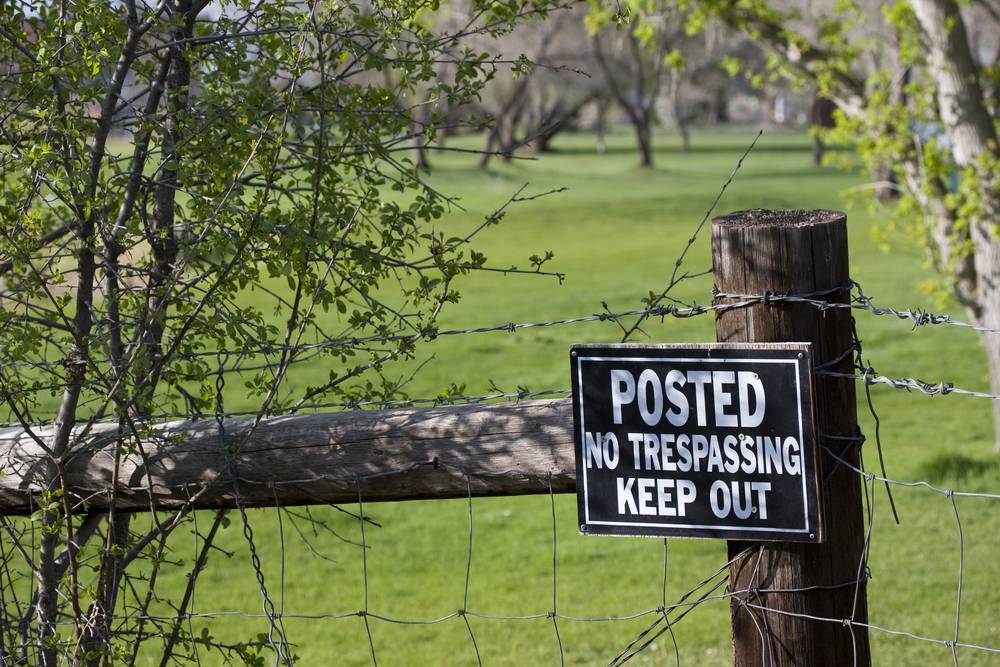
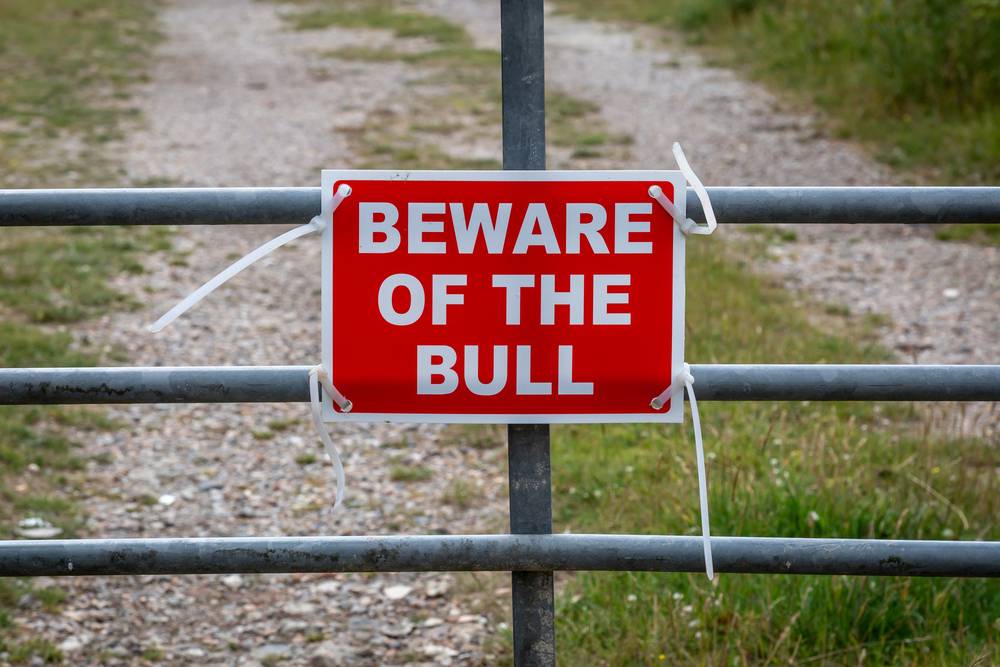
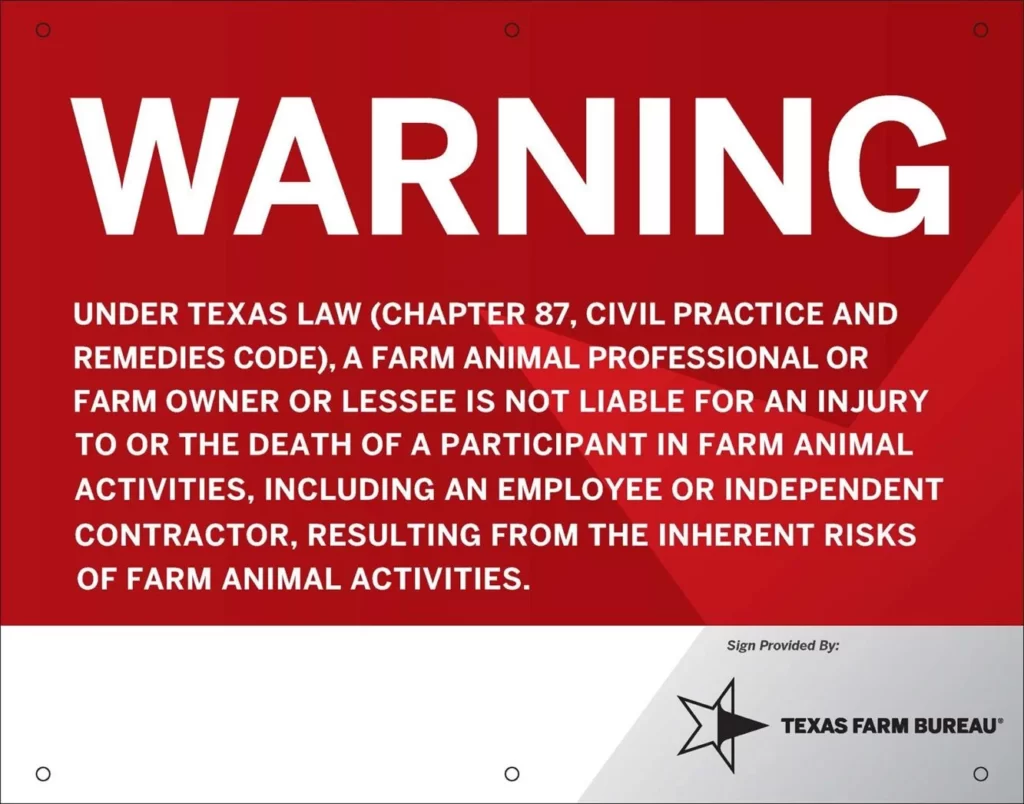
Dowell-Lashmet pointed out that the highest duty a landowner owes is to notify visitors of dangers and mitigate those dangers wherever possible: Plug abandoned wells and install warning signs; Warn of potentially hidden dangers (barbed wire, dangerous terrain, etc.); Install signage warning of unpredictable farm animals.
Written liability waivers are essential and must be drafted by an attorney and updated on a regular basis. Case law changes!
Owning your land through a business entity offers certain protections to your other assets. However, this can be cumbersome to manage and one must be diligent to maintain the corporate veil. My own note here: If you are financing your property this may be even more difficult, as this will likely push you into a commercial loan.
Texas has limited liability statutes that can be helpful. However, each has its own limitations and advisement requirements. These statutes include the Texas Recreational Use Statute, the Texas Agritourism Act, and the Texas Farm Animal Liability Act. You can learn more at www.AgriLife.org/TexasAgLaw.
While there are many methods in Texas to help protect landowners from malicious litigation, common sense prevails. Remove and remediate hazards, inform visitors about potential hazards and risks and make efforts to ensure the safety of guests and interlopers alike in order to minimize your land liability.
Check out my other blog post on choosing a homestead property here.